Phil Black.

Phil Black

Business Analyst | Process Improvement | AI Workflow Automation

I find where manual work, paper hand-offs and messy data slow people down, then design simpler digital workflows that fix the cause. My experience comes from real local-government operations: waste services, field work and animal management.

Five case studies. 50 pages in total. Opens in your browser, no software needed.

At a glance Melbourne, Victoria Australian citizen, full working rights MCSE ITIL v3 Foundation Advanced Certificate in IT

Business analysis portfolio

Each case study is a short PDF that walks through the current process, the root causes, the redesigned process and the expected benefits. Choose Read PDF to open it in your browser, or Download to save a copy.

Case study 01

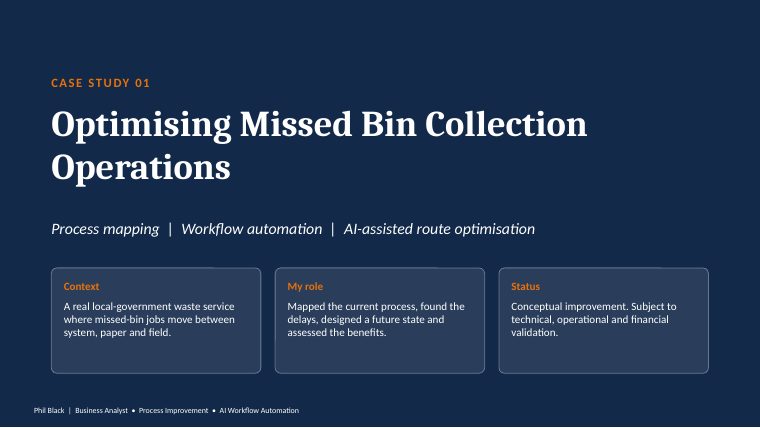
Optimising missed bin collection operations

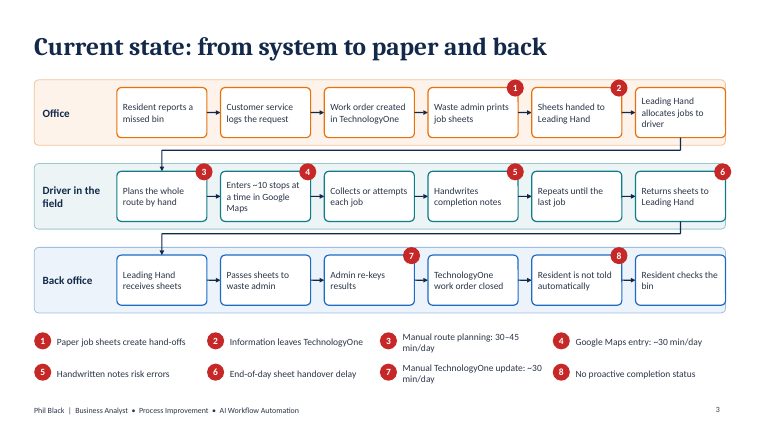
A paper-based missed-bin workflow forced drivers to plan routes by hand and retype addresses, then admin staff re-entered the results into the work order system.

What I did
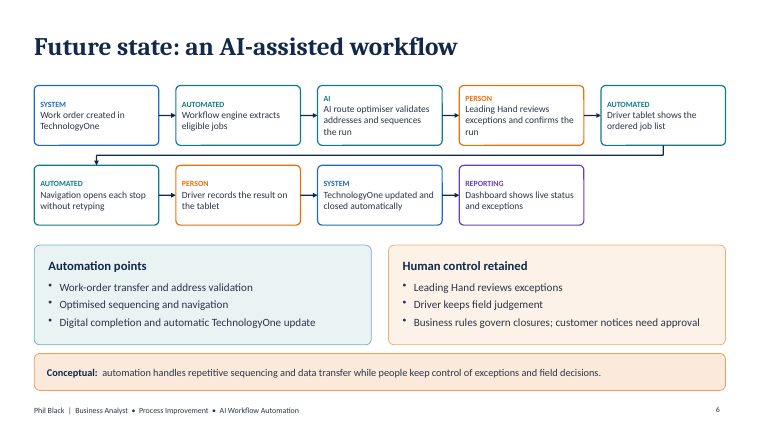
Mapped the current process, identified the delays, and designed an AI-assisted future state with route sequencing and automatic status updates.
Estimated opportunity
Around 60–75 minutes of driver time per day, and a potential 10–15 extra jobs completed daily. These are estimates to be validated in a pilot.
  • Process mapping
  • Root cause analysis
  • AI route optimisation
  • Business case
Read PDF Download

11 pages · 0.2 MB

Case study 02

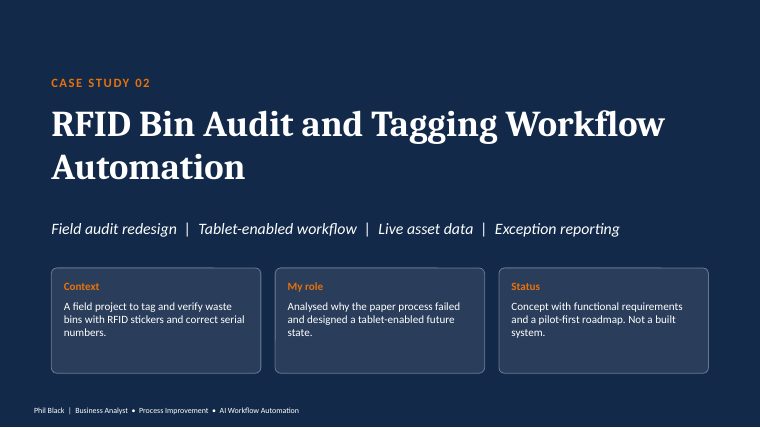
RFID bin audit and tagging workflow automation

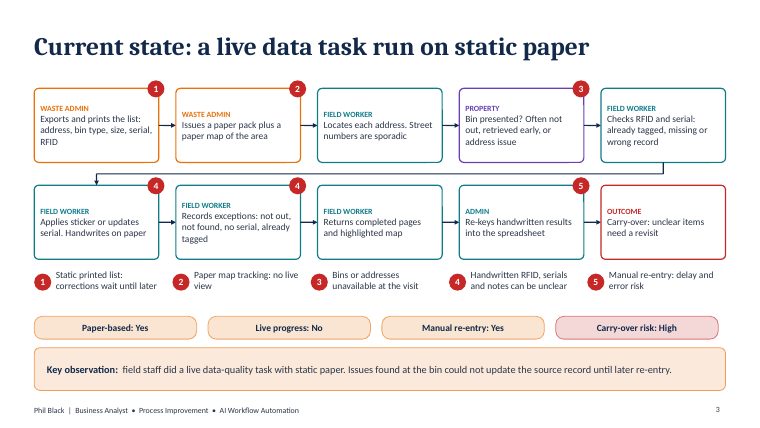
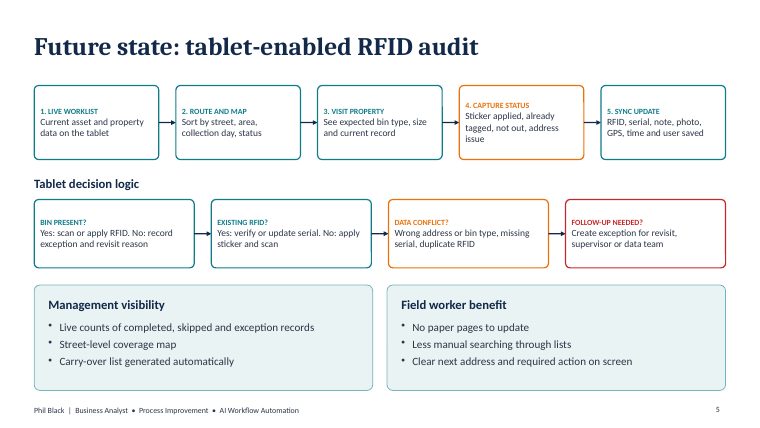
A field tagging project struggled because staff used printed spreadsheets and paper maps for a task that needed live data. The problem was the workflow and the data, not the RFID stickers.

What I did
Analysed why the paper process failed, then designed a tablet-enabled audit workflow with a live worklist, validation rules and exception reporting.
Outcome
A functional requirements set, conceptual architecture and a pilot-first roadmap.
  • Field process redesign
  • Requirements
  • Asset data quality
  • Exception handling
Read PDF Download

11 pages · 0.2 MB

Case study 03

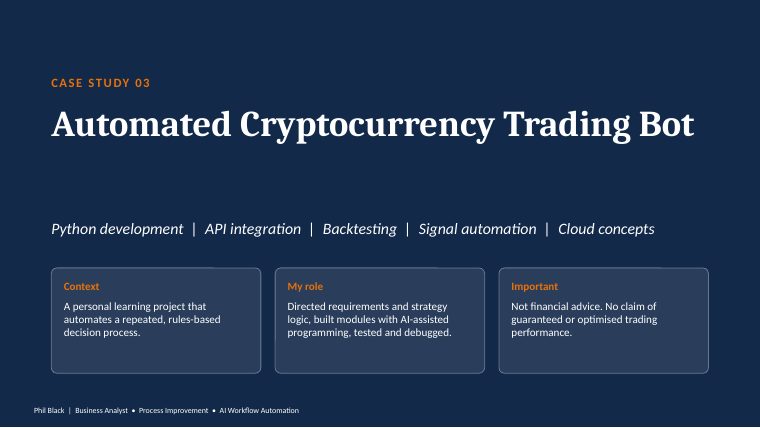
Automated cryptocurrency trading bot

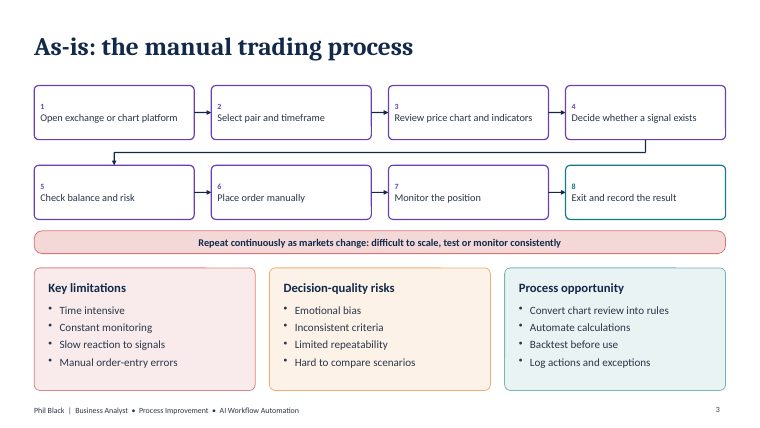
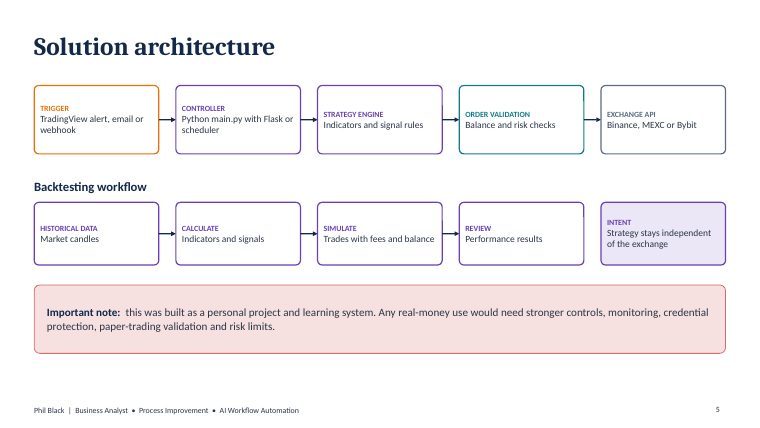
A personal development project that turns a manual, repeated chart-review routine into a rules-based Python system with backtesting, logging and cloud deployment concepts.

What I did
Directed the requirements and strategy logic, built the modules with AI-assisted programming, and troubleshot API, data and deployment issues.
Note
A learning project that shows systems thinking and technical problem-solving. It is not financial advice and makes no performance claims.
  • Python
  • API integration
  • Backtesting
  • Risk and governance
Read PDF Download

13 pages · 0.3 MB

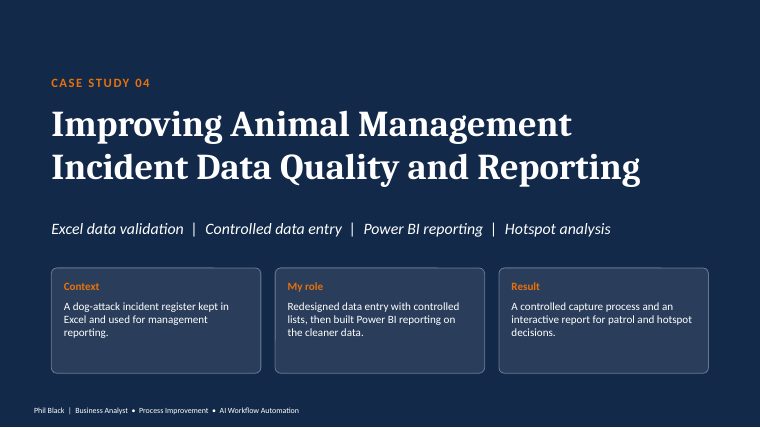
Case study 04

Improving animal management incident data quality and reporting

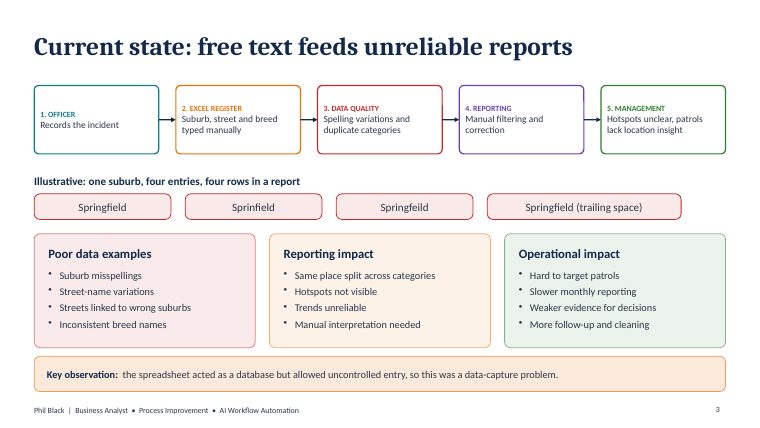
A dog-attack register built on free-text Excel fields produced misspelt suburbs, duplicate breeds and unreliable hotspot reports.

What I did
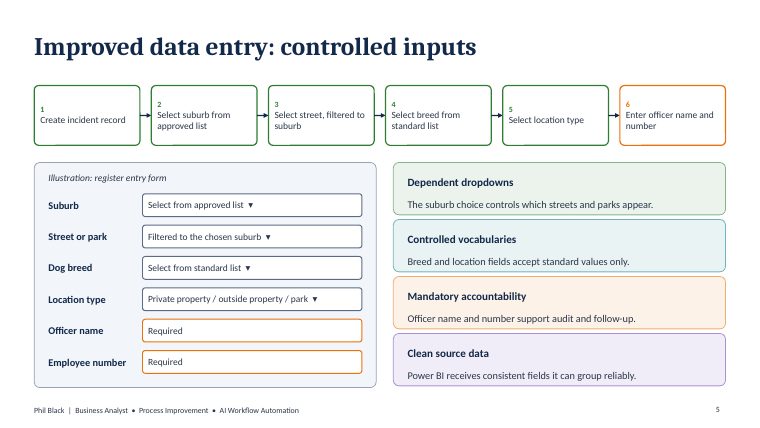
Redesigned data entry with suburb-dependent street lists, standard breed and location categories and required officer details, then built a Power BI report on the cleaned data.
Outcome
Cleaner data and interactive hotspot reporting that management could filter and drill into.
  • Excel data validation
  • Data governance
  • Power BI
  • Hotspot analysis
Read PDF Download

10 pages · 0.2 MB

Case study 05

Power BI reporting: operational dashboards

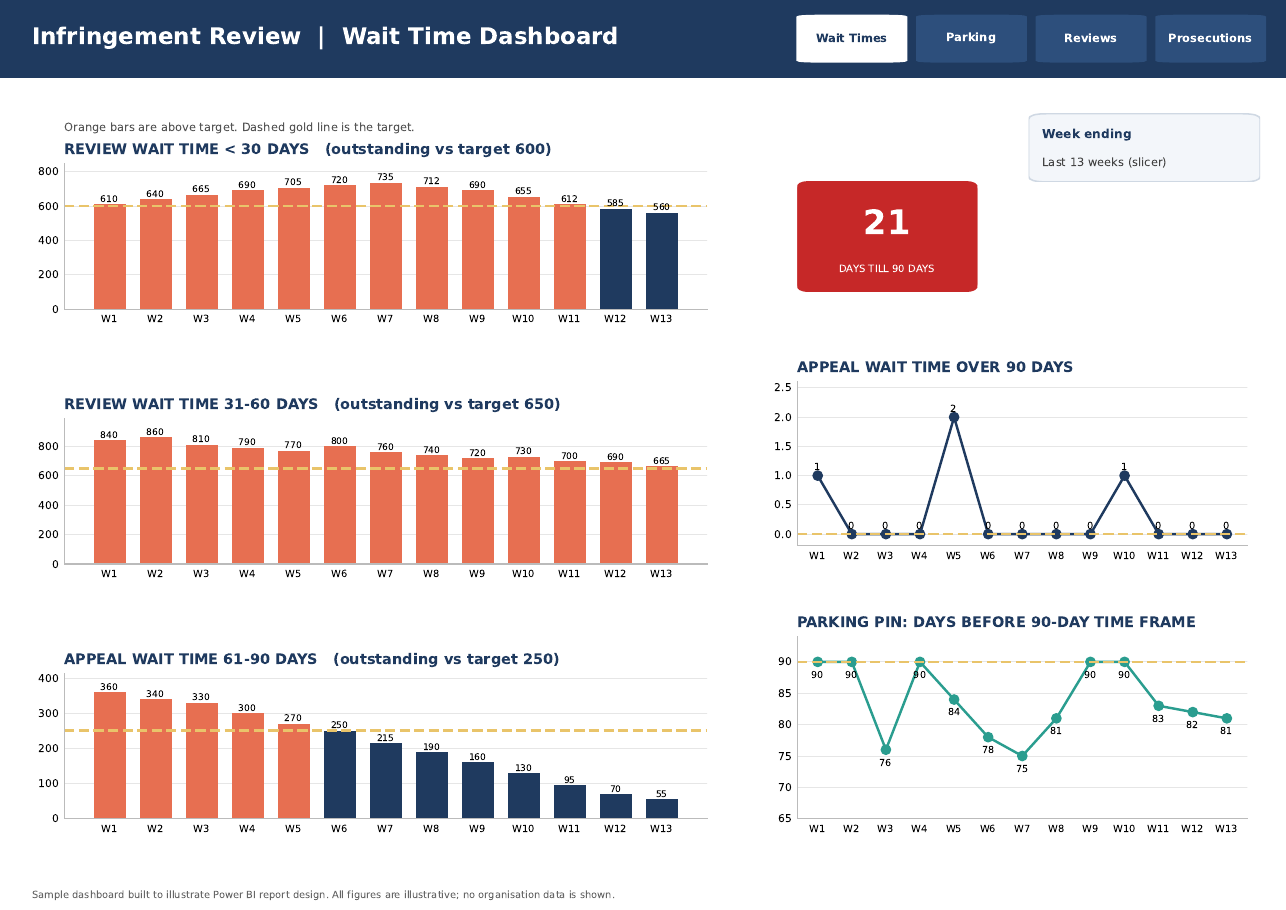
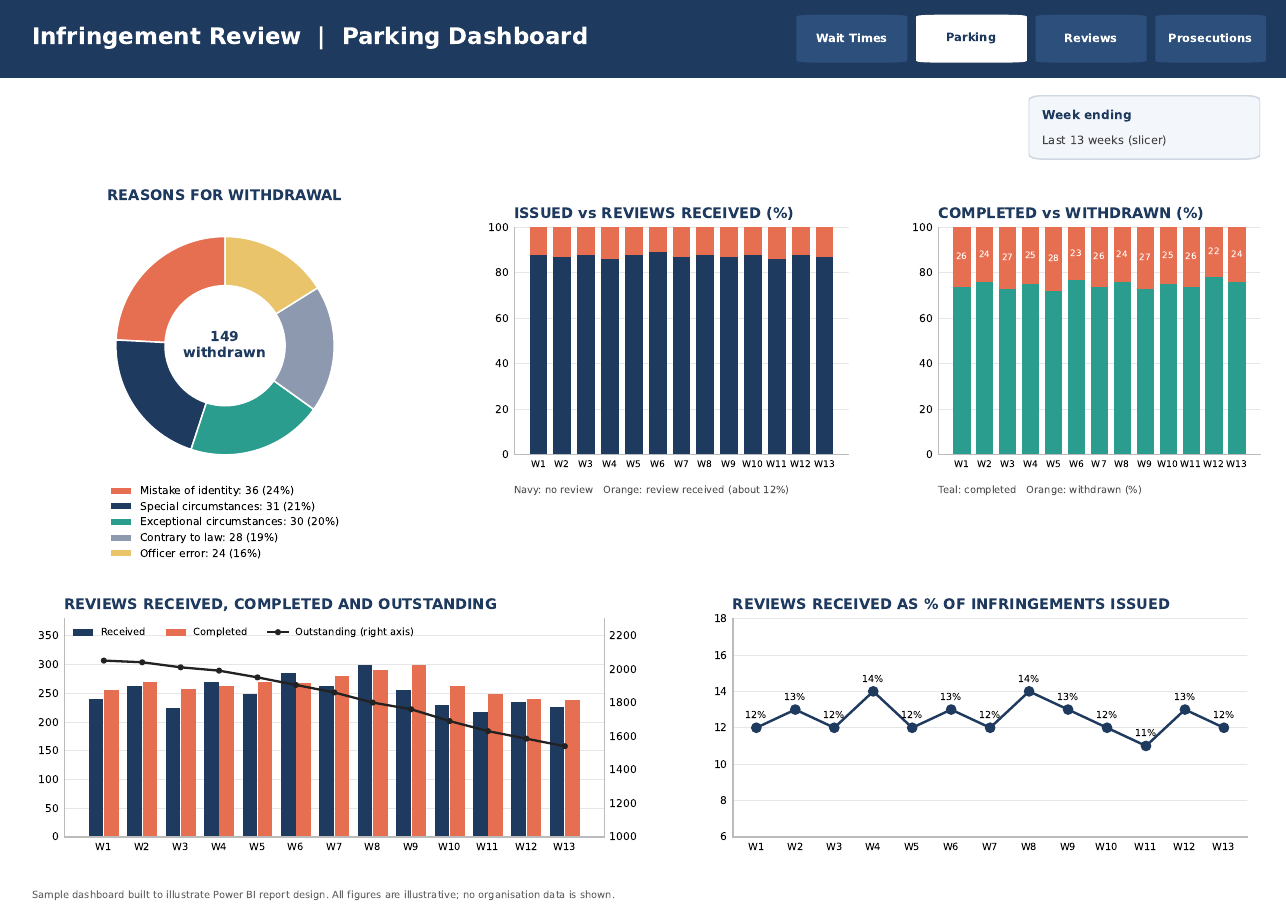
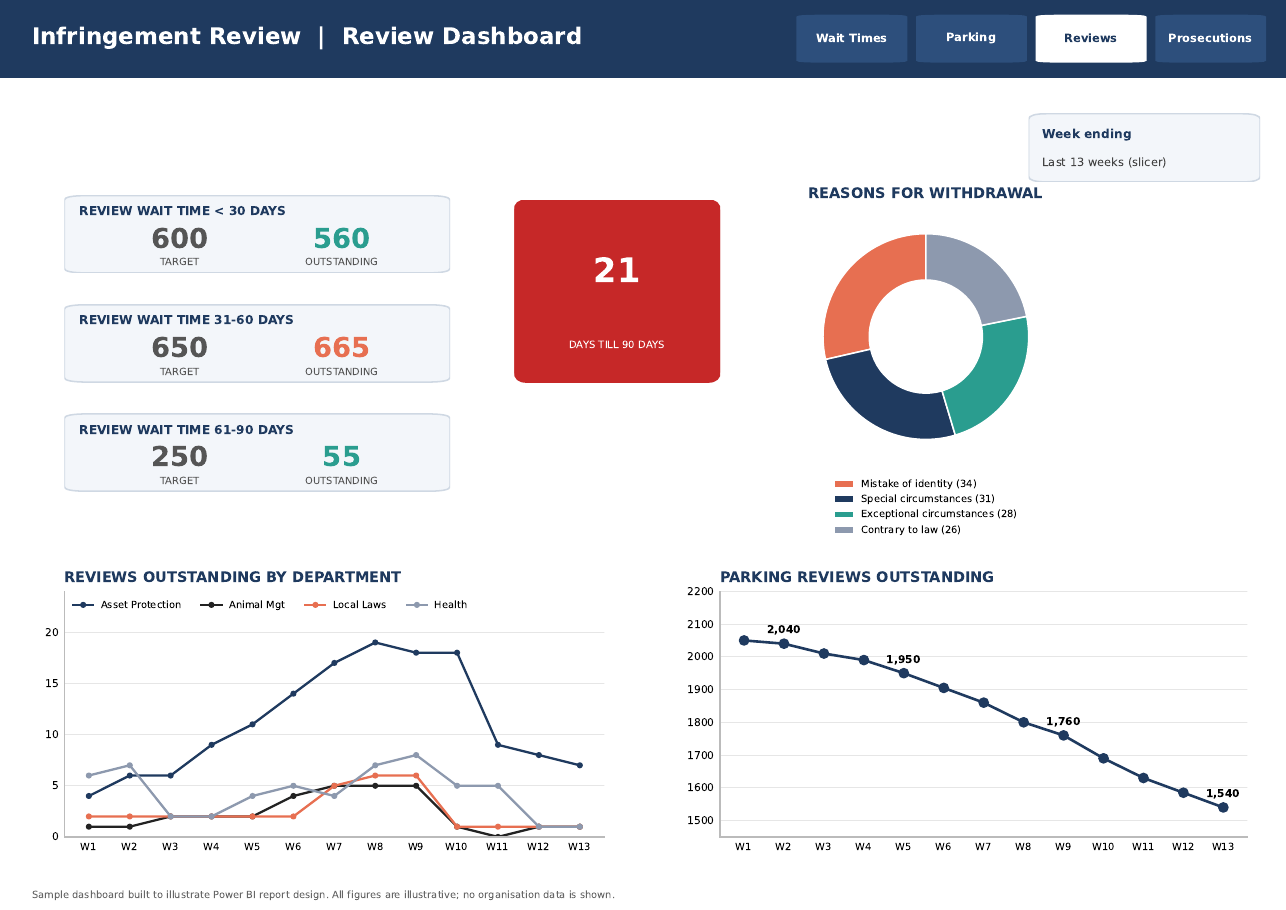
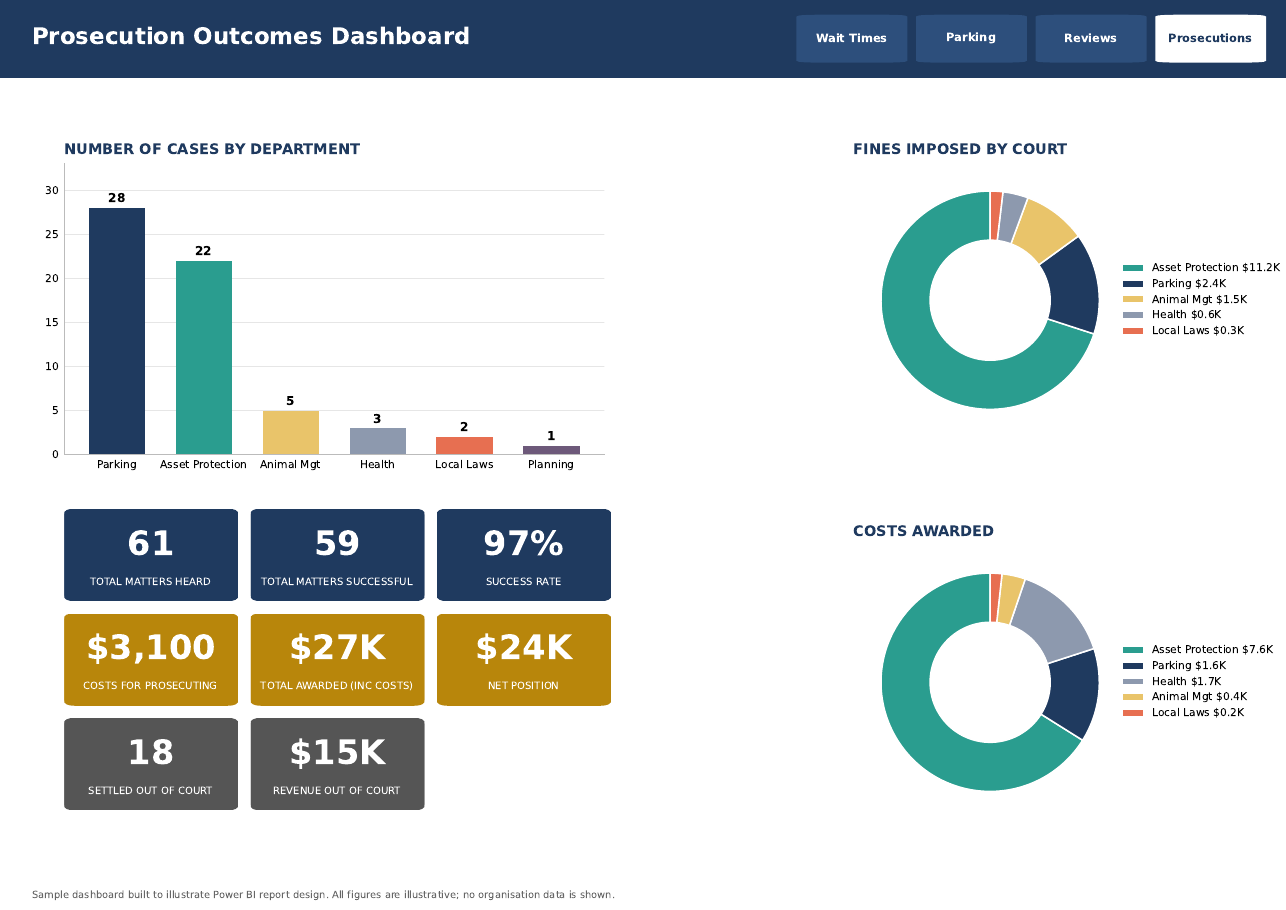
Sample versions of the Power BI report designs I created for department managers in local government, covering service wait times, reasons for withdrawal, review backlogs and prosecution outcomes.

What I did
Designed dashboards that track wait times against targets, show reasons for withdrawal and backlogs by department, and summarise prosecution outcomes and costs.
Note
Shown with illustrative sample data. The layouts are based on reports I designed, and no organisation names or real data are included.
  • Power BI
  • KPIs and targets
  • Dashboard design
  • Trend analysis
Read PDF Download

5 pages · 0.1 MB

Prefer one file?

All five case studies combined: 50 pages, 0.9 MB.

How I work

The same four steps run through every case study, whether the problem is a collection route or a spreadsheet.

Observe the real process

Follow the work from request to completion, including the paper, the workarounds and the hand-offs.

Find the root cause

Separate symptoms from causes, then rank issues by impact so effort goes where it matters.

Design the future state

Capture data once, at the source, with people still in control of exceptions and judgement calls.

Prove it before scaling

Baseline the numbers, pilot in a small area, then roll out once the benefits are confirmed.

What I bring to a business analyst role

Business analysis

  • Current-state and future-state mapping
  • Requirements and exception analysis
  • Root cause and issue prioritisation
  • Executive summaries

Process improvement

  • Waste and rework identification
  • Paper-to-digital redesign
  • Baseline measurement
  • Staged pilots and roll-out plans

Data and reporting

  • Data quality and governance
  • Excel validation and reference data
  • Power BI dashboards
  • Hotspot and trend analysis

Digital and AI

  • AI opportunity assessment
  • Workflow automation concepts
  • Python and API integration
  • Business case frameworks

About Phil

I am a business analyst with a practical, operations-first background. I have worked close to the people who do the work, so I look for improvements that fit how a depot or a field crew really operates.

I am particularly interested in roles where process improvement, data quality and sensible use of automation and AI can make a measurable difference to service delivery.

Case studies are based on real operational processes. Proposed improvements and estimates are conceptual and subject to technical, operational and financial validation. The Power BI sample uses illustrative data.

Hiring a business analyst?

Read the portfolio first, then get in touch. I am happy to walk through any case study in an interview.